Four Tools, Four Blockages: Equipment Choices in Cidade Patriarca
Four Tools, Four Blockages: Equipment Choices in Cidade Patriarca
When a crew pulls up and starts unloading a manual snake, an electric auger, a hydrojetter, and a suction truck for what looks like the same clogged drain, the natural question is why they brought four machines instead of one. The answer is simple: a blockage is not just a blockage. Its location, the pipe material, the cause, and the surrounding infrastructure determine which tool will clear it efficiently and which will waste time or damage the line. For residents and property managers searching for a desentupidora em Cidade Patriarca São Paulo SP, understanding this equipment logic helps set realistic expectations about time, cost, and the risk of recurrence.
The Nature of Blockages in Cidade Patriarca
Cidade Patriarca is a densely built neighborhood in São Paulo’s Zona Leste, where residential streets mix with commercial corridors and older infrastructure. Many buildings date back decades, with clay or cast-iron sewer laterals, narrow kitchen lines, and shared storm drains. Others are newer but still connect to the same municipal network. That mix produces a predictable range of blockages: grease and soap scum in kitchen lines, hair and lint in bathroom drains, roots and sediment in yard drains, and solid waste or scale in main sewer laterals.
Each of these behaves differently. Grease cools and congeals on pipe walls, narrowing the passage without fully sealing it at first. Roots enter through joints and expand over time, creating a basket-like obstruction. Sediment and scale accumulate gradually, especially in low-slope sections. Solid objects, from wipes to small toys, lodge at bends or transitions. Matching the tool to the blockage type is what separates a fifteen-minute job from a three-hour ordeal.
Manual Snake: The First Responder for Short, Simple Clogs
The manual snake, also called a hand auger or drain snake, is a coiled steel cable with a small auger head that a technician feeds into the drain by hand. It works best on short runs, typically within two to five meters of the access point, and on blockages that are soft or loose enough to be hooked and pulled back. In Cidade Patriarca, it is the go-to tool for a bathroom sink that drains slowly because of hair and soap residue, or a floor drain with a small accumulation of debris near the grate.
The advantage is control. The technician feels resistance directly through the cable, which helps avoid pushing a clog deeper or scratching a fragile pipe. The limitation is reach and power. A manual snake cannot clear a main sewer lateral thirty meters from the cleanout, and it will not cut through roots or compacted grease. When a crew arrives and starts with a manual snake, it is usually a diagnostic move: confirm the blockage is close and soft before deciding whether a larger machine is needed.
Electric Auger: Power for Longer Runs and Tougher Clogs
The electric auger, or power snake, scales up the same principle. A motor rotates a heavier cable, often with interchangeable heads for cutting, piercing, or retrieving. It reaches further, typically fifteen to thirty meters depending on the cable and the number of bends, and it generates enough torque to break through compacted grease, scale, and light root intrusions. In Cidade Patriarca, it is common in apartment buildings where the stack or the lateral has a stubborn clog that a hand tool cannot reach.
This is also the tool that requires the most judgment. A powerful auger in the wrong hands can crack a brittle clay pipe or bind in a root mass and damage the cable. Technicians typically use an electric auger when the clog is confirmed to be within reach and the pipe material can tolerate the torque. It is less effective on heavy root systems that have filled the pipe diameter, and it does not clean the pipe walls, so grease and sediment remain and can cause a repeat blockage.
Hydrojetter: High-Pressure Cleaning for Grease, Scale, and Roots
The hydrojetter uses a high-pressure water stream, often between 1,500 and 4,000 PSI, delivered through a hose with a specialized nozzle that propels itself down the pipe and blasts the walls in a 360-degree pattern. It is not just a clearing tool; it is a cleaning tool. In Cidade Patriarca, it is the standard choice for restaurant kitchen lines, condominium grease traps, and main laterals where grease, soap, and scale have coated the pipe over months or years.
Hydrojetting is also effective against roots, because the high-pressure stream can cut through softer root masses and flush the debris away. The trade-off is that it requires an adequate water source, a larger access point, and a pipe in reasonable condition. Hydrojetting a severely deteriorated pipe can worsen an existing crack, so a camera inspection often precedes the job. When a crew brings a hydrojetter, it is usually because the blockage is widespread or recurrent, not a single localized clog.
Suction Truck: Volume Removal for Sewer and Fossa Blockages
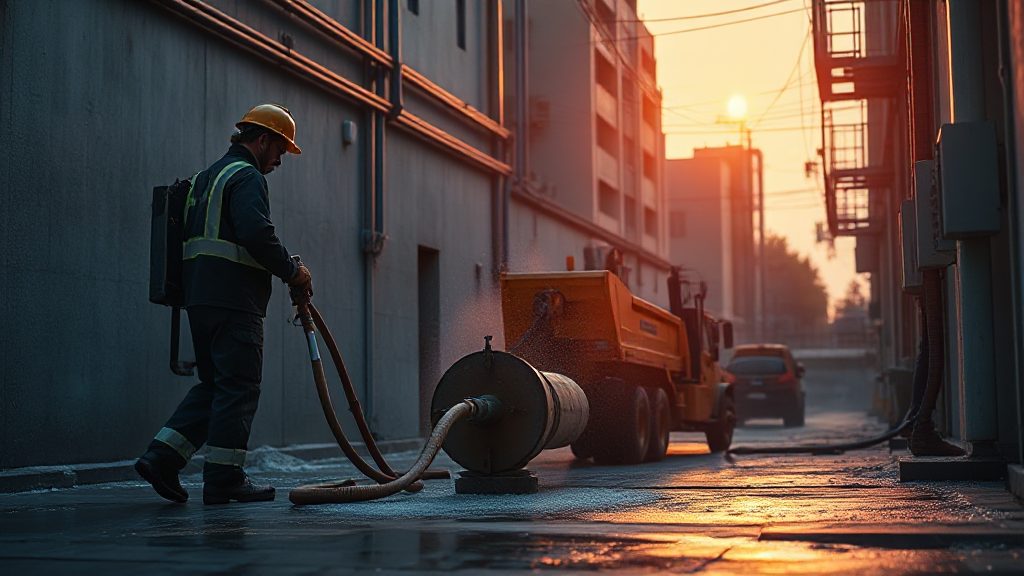
The suction truck, or vacuum truck, uses a high-capacity pump to remove liquid and semi-solid waste from a sewer line, a septic tank, or a storm drain. It is the tool of choice when the problem is not a single obstruction but an accumulation: a sewer lateral filled with solids, a fossa séptica that needs emptying, or a catch basin choked with sediment and debris. In Cidade Patriarca, suction trucks are frequently paired with hydrojetting: the vacuum removes the bulk material, and the hydrojetter cleans the walls afterward.
This is also the tool that makes the difference in emergency situations, such as a backed-up sewer in a commercial building during business hours. A desentupidora Cidade Patriarca that operates 24 hours can dispatch a suction truck at night, when access to the street and the building is easier and the disruption to tenants is minimal. The limitation is access: the truck needs to park reasonably close to the cleanout, and the hose run has practical limits.
Mapping Tools to Blockages: A Practical Comparison
The table below summarizes how each tool maps to the blockage types most commonly found in Cidade Patriarca. It is a guide, not a rigid rule; experienced technicians often combine tools in sequence.
| Tool | Best For | Typical Reach | Limitations |
|---|---|---|---|
| Manual snake | Hair, soap, small debris near the drain | 2–5 m | Cannot cut roots or clear main lines |
| Electric auger | Compacted grease, scale, light roots in laterals | 15–30 m | Risk to fragile pipes; does not clean walls |
| Hydrojetter | Grease-coated lines, heavy roots, recurrent clogs | 30–60 m | Needs water source and sound pipe condition |
| Suction truck | Sewer backups, fossa séptica, sediment-filled drains | Hose-dependent | Requires truck access near the cleanout |
In practice, a typical residential call in Cidade Patriarca might start with a manual snake to confirm the clog is close, move to an electric auger if the blockage is deeper, and finish with a hydrojetter if the pipe walls are coated. A commercial or condominium call with a sewer backup often starts with the suction truck to remove volume, then hydrojetting to clean. The sequence matters as much as the tool: removing bulk first prevents the auger or jetter from pushing solids further down the line.
For property managers comparing quotes, the key question is not which tool is cheapest but which tool matches the blockage. A quote that proposes only a manual snake for a recurrent main-line clog is likely to result in a repeat call. A quote that proposes hydrojetting for a simple hair clog in a bathroom sink is overspecified. The right desentupidora Cidade Patriarca São Paulo SP will ask about the symptoms, the pipe material, and the history of the problem before recommending equipment.
Understanding this mapping also helps residents ask better questions. If a technician arrives with only a manual snake and the problem is a backed-up sewer line, it is reasonable to ask whether a suction truck or hydrojetter is needed. If the problem keeps returning, the conversation should shift from clearing to cleaning and inspection. In a neighborhood like Cidade Patriarca, where old and new infrastructure coexist, the crew that brings the right mix of tools is the one that solves the problem rather than postponing it.